
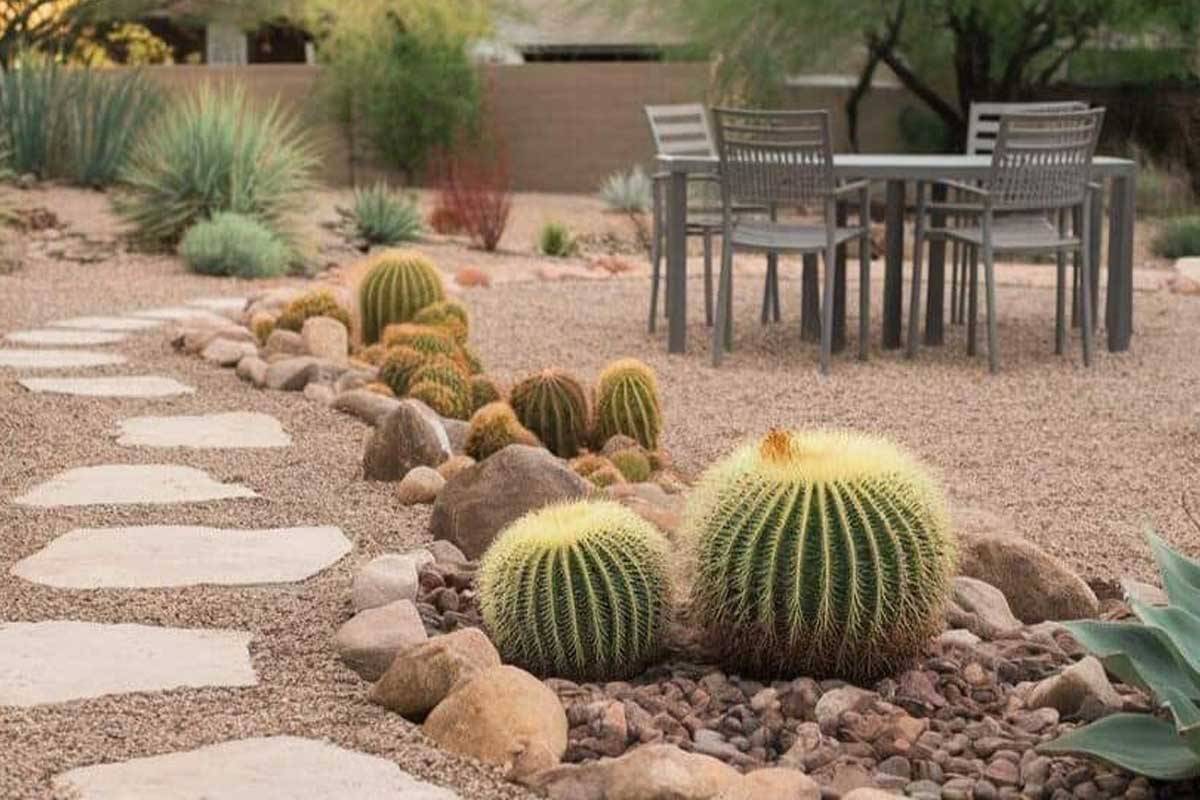
Quick answer: A desert landscape combines drought tolerant planting with gravel, rock and sand in place of lawn and mulch. The look is built from sculptural succulents and cacti, deliberate texture contrast, a few strong focal points, and water-wise design principles. In Adelaide the critical detail is drainage, because winter rain, not summer heat, is what kills these gardens.
The style has obvious appeal here. It looks striking, it uses very little water, and it suits the hot dry summers that make conventional gardens hard work. Done well it is one of the lowest upkeep options available.
Done badly it becomes a gravel car park with a few sad plants in it. The difference is almost entirely down to planning, so this guide covers what actually makes a desert landscape work on an Adelaide block, from plant selection through to the ground you spread underneath them.
Zero
Mowing Required
5
Design Principles That Matter
Res + Com
Residential & Commercial
Free
No-Obligation Site Quotes
Choosing the Right Succulents and Cacti
Build the planting around a few large architectural specimens, fill between them with mid sized clumping succulents, and finish with low spreading ground cover. Choose for mature size and winter wet tolerance rather than how the plant looks in a pot at the nursery.
The plants are what make a desert landscape read as designed rather than accidental. Scale is the tool that does most of the work: three sizes of plant, used deliberately, create depth that a flat sea of identical succulents never will.
Structural specimens: agave, yucca, aloe and larger cacti give you the vertical statements. Use them sparingly, as anchors. Check the mature spread before planting, because agaves in particular get considerably wider than people expect.
Mid layer clumping: echeveria, aeonium, crassula and cotyledon fill the middle ground with rosette shapes and colour. This layer is where most of the visual variety lives.
Ground cover: sedum, senecio and trailing succulents soften edges, spill over rocks and knit the composition together at ground level.
The Adelaide Catch: Winter, Not Summer
Most succulent and cacti losses here happen in the cold wet months, not through the heat. Sitting in saturated clay is what does the damage.
Protect Against Winter Wet:
- Raise beds or mound planting areas so water drains away from the crown.
- Improve heavy clay with coarse sand and grit before planting, not after.
- Position on the sunniest, most open part of the block wherever possible.
- Avoid low spots where runoff naturally collects after rain.
Using Gravel, Rocks, and Sand
Gravel replaces both lawn and organic mulch, suppressing weeds while letting water through to the root zone. Rock provides the larger scale structure. Keep the palette limited, vary the particle size, and always lay over a properly prepared and edged base.
Ground surface is roughly two thirds of what you see in a desert landscape, so it deserves more thought than it usually gets. The most common mistake is treating gravel as filler. Handled properly it is the element that ties everything else together.
- Limit the palette. One or two gravel tones across the whole garden. Mixing four different colours reads as indecision rather than variety.
- Vary the grade, not the colour. Fine decomposed granite for paths against coarser gravel in beds creates contrast without visual noise.
- Use boulders in odd numbers. Groups of three or five, partially buried so they look settled rather than dropped on the surface.
- Prepare the base. Weed suppression, correct depth and proper compaction underneath determine whether the surface stays clean or turns to mud.
- Edge everything. Without a defined edge, gravel migrates onto paths and lawn within a season. Garden edging is not optional here.
Sand suits contained areas such as a dry creek bed or a courtyard feature, but it moves in wind and rain, so it needs firm containment. For paths and seating areas, paving is usually the more practical choice. Our paving Adelaide team can integrate hard surfaces with the gravel areas so the transitions stay clean.
Creating Texture and Focal Points
With a restrained colour palette, texture carries the design. Contrast spiky against rounded, matte against glossy, fine against coarse. Then give the eye somewhere to land with one or two deliberate focal points rather than scattering interest evenly.
What Makes a Desert Landscape Look Designed
Gardens in this style live or die on composition, because there is no flowering season to hide behind. Everything is visible all year, which means every placement is permanent in a way it is not in a conventional garden.
- Contrast the forms. A spiky agave beside a rounded barrel form beside a soft trailing sedum. Three shapes together always reads better than three of the same.
- Plant in drifts. Repeating one species in a group is stronger than a single specimen of many species dotted about.
- Choose one hero per view. A specimen plant, a boulder group, a fire pit or a piece of sculpture. Two competing heroes cancel each other out.
- Use light deliberately. Low uplighting on architectural plants throws shadows that make the garden work after dark as well as during the day.
- Leave breathing room. Open gravel is part of the composition, not wasted space waiting to be filled.
Composition Is Hard to Fix Later
Have the Design Drawn Before You Plant
We plan levels, drainage, surfaces and planting as one scheme, so the garden works on paper before anything is ordered.
Water-Wise Garden Design Principles
Group plants by water need, zone the irrigation to match, prepare the soil so it drains freely, and direct roof and surface runoff to where it is useful rather than where it pools. Low water does not mean no water, particularly through the establishment period.
A desert landscape is water-wise by nature, but the design decisions underneath it still determine how much water it actually uses. The single biggest gain comes from hydrozoning, which simply means not running thirsty and drought tolerant plants off the same valve.
- Zoned drip irrigation for beds, run and timed independently from any remaining lawn or pots.
- Deep, infrequent watering to encourage roots downward instead of shallow daily sprinkling.
- Soil preparation first. Free draining soil is what allows these plants to survive on very little.
- Capture what falls. Shallow swales and considered grading direct rainfall into planting areas rather than off the block.
- Plan for establishment. Even drought tolerant species need consistent water through their first summer before they can fend for themselves.
Thriving Plants for Adelaide’s Climate
Adelaide has a Mediterranean climate, with hot dry summers and mild wet winters, rather than a true desert one. That means the plants that thrive are those handling both heat and winter moisture, which brings drought tolerant natives and Mediterranean species into play alongside the succulents.
This is where a strict interpretation of the style is worth relaxing slightly. Blending in local and Mediterranean plants gives you movement, seasonal change and habitat value, and it makes the garden considerably more forgiving through a wet July.
Reliable Choices
- ✅ Agave, aloe, yucca and cotyledon for structure.
- ✅ Kangaroo paw, dianella and native grasses for movement.
- ✅ Westringia and correa for evergreen form.
- ✅ Rosemary, lavender and olive for Mediterranean texture.
Approach With Caution
- ⚠️ Frost tender species on exposed Hills blocks.
- ⚠️ Anything sharp beside paths, play areas or gates.
- ⚠️ Vigorous spreaders that escape into neighbouring gardens.
- ⚠️ Bare rooted succulents planted straight into unimproved clay.
Check your specific conditions before committing to a list. Aspect, soil, frost exposure and proximity to the coast all shift what will work, and a plant that thrives in a north facing Prospect courtyard may struggle on an exposed block in the Hills.
Designed for Your Conditions
Adelaide Landscaping Group chooses plants to suit your soil, light and local climate rather than a template, and prioritises sustainable practices including native planting, water efficient irrigation and environmentally responsible materials. Licensed and insured under BLD 179371.
A desert landscape rewards restraint more than almost any other style. Fewer species, fewer materials, fewer competing focal points, and a great deal of attention paid to drainage and to what sits underneath the gravel. Get those decisions right at the start and the garden largely runs itself. To have the whole scheme planned properly for your block, contact our team for a site visit and quote.
