
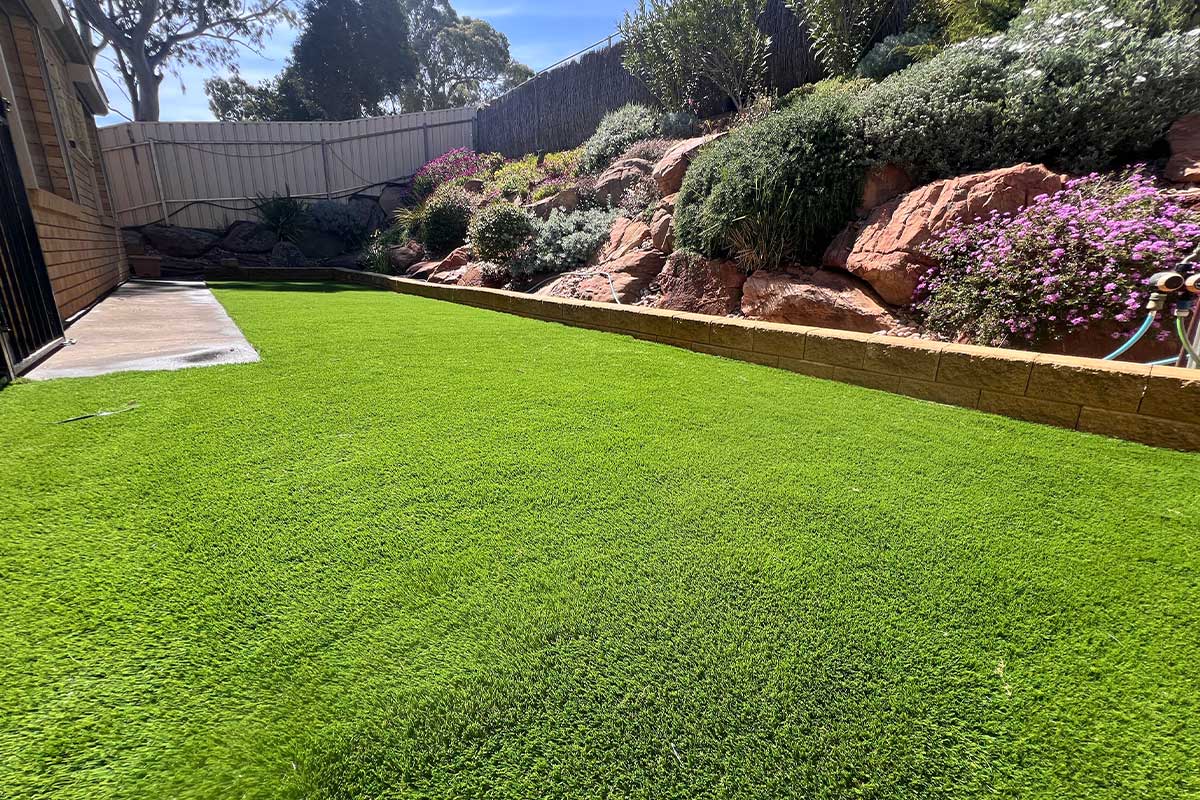
Quick answer: Low maintenance garden landscaping rests on five decisions: plant natives suited to the local climate, replace thirsty lawn with quality artificial turf, use paving and hardscaping to reduce the area that needs tending, mulch every garden bed properly, and put the watering on a zoned irrigation system. Each one removes a recurring job rather than just delaying it.
Most yards are not high maintenance by design. They end up that way through a series of small decisions: a lawn that needs constant water, plants chosen from a photo rather than for the soil, bare beds that grow weeds faster than anything else, and a hose dragged around by hand every second evening.
The good news is that the reverse is also true. Smart garden landscaping choices made once, at the start, can strip hours off your weekends permanently. Here are five that make the biggest difference on Adelaide blocks, in rough order of impact.
5
Changes That Cut Upkeep
Zero
Mowing With Artificial Turf
Res + Com
Residential & Commercial
Free
No-Obligation Site Quotes
Embrace Native Australian Plants
Native and locally suited plants have already adapted to the rainfall, heat and soil they are planted into. Once established they need far less water, less feeding and less intervention than exotic species fighting conditions they were never built for.
This is the highest leverage decision in low maintenance garden landscaping, because it determines how much work every following summer creates. The trick is choosing plants that suit your soil, light and local climate rather than what looked good in a photo at the nursery.
Native does not mean sparse or scrubby either. Grevilleas, correas, westringia, kangaroo paw, dianella and native grasses give you colour, texture and structure through the year, and most of them bring birds and pollinators with them.
Getting Native Planting Right
Natives are low maintenance once established, but the establishment phase still needs a plan.
Before You Plant:
- Match species to the actual aspect, because full western sun is a different brief to a shaded side yard.
- Improve the soil first, particularly on the clay heavy ground common across many Adelaide suburbs.
- Group plants by water need so the thirsty ones are not dictating how you water everything else.
- Allow for mature size, so you are not pruning constantly to keep something in a space too small for it.
Consider High-Quality Artificial Turf
Artificial turf removes mowing, watering and fertilising from the calendar entirely. It stays green year round regardless of season, handles strong sunlight and heavy foot traffic, and is durable, pet friendly and weather resistant.
Natural lawn is usually the single biggest consumer of time and water in a yard. Adelaide’s climate is hard on it, and keeping it looking good through summer is a losing battle for most households. Replacing it is the change people notice fastest.
Natural Lawn
- ⚠️ Regular mowing, edging and fertilising.
- ⚠️ Ongoing water use through summer.
- ⚠️ Patchy or dormant during heat and dry spells.
- ⚠️ Mud and wear in high traffic areas.
Quality Artificial Turf
- ✅ No mowing, watering or fertilising.
- ✅ Green all year regardless of season.
- ✅ Durable, pet friendly and weather resistant.
- ✅ Lower water bills and upkeep costs over time.
Installation quality is what separates turf that still looks right in five years from turf that ripples, shifts or drains badly. Proper ground preparation, quality underlay and precise joins matter more than the product spec sheet. Our artificial turf installation team handles residential lawns, commercial properties and recreational areas across Adelaide.
Use Paving and Hardscaping for Style
Every square metre of paving is a square metre that never needs mowing, watering or weeding. Professional paving delivers a durable, low maintenance surface that improves kerb appeal and can increase property value, using materials selected to handle temperature swings and heavy rain.
Hardscaping is the structural half of garden landscaping, and it is what stops a low maintenance yard from feeling empty. Paths, courtyards, edging and level changes give the space shape, so the planting can be generous in a few well chosen places rather than spread thin everywhere.
- Patios, paved areas and courtyards that turn unused lawn into usable outdoor living space.
- Paths and stepping stones that stop foot traffic wearing tracks through garden beds.
- Garden edging that holds mulch in place and keeps a clean line between bed and surface.
- Retaining and garden stairs that make a sloping block level, accessible and far easier to maintain.
- Built-in seating, planters and screening that add function without adding upkeep.
A common mistake is paving everything and ending up with a heat trap. The balance worth aiming for is hard surface where you actually walk, sit and entertain, planting everywhere else. See our paving Adelaide and retaining walls services for the structural side.
Plan It Once, Enjoy It For Years
Get a Low Maintenance Plan for Your Block
We assess your soil, aspect, slope and how you actually use the space, then design around all four. Free site visit, written quote.
The Benefits of Mulching
Mulch suppresses weeds, holds moisture in the soil, moderates soil temperature through heat and cold, and slowly improves soil structure as it breaks down. It is the cheapest maintenance reduction available in any garden.
Bare soil is an invitation. Weed seeds land on it, water evaporates off it, and the surface bakes hard through summer. A properly laid mulch layer solves all three at once, which is why it appears in almost every low upkeep garden that actually works.
Where Mulch Fits Into Your Garden Landscaping
- Depth matters. Too thin and weeds push through. Too thick against stems and you invite rot. Aim for an even layer across the bed.
- Keep it off the trunks. Pull mulch back slightly from the base of trees and shrubs rather than mounding it against them.
- Match the mulch to the bed. Coarse bark holds up in exposed areas, finer composted mulches feed the soil faster in established beds.
- Mulch over irrigation, not under it. Drip line beneath the mulch delivers water straight to the root zone with minimal evaporation.
- Top it up. Organic mulch breaks down, which is the point. Expect to refresh it periodically rather than treating it as permanent.
Smart Irrigation Systems
A well designed system waters plants properly without you standing there holding a hose. Drip lines, sprinklers and controllers are zoned separately for lawns, garden beds and pots, then programmed once so the garden looks after itself.
Zoning is the part most DIY systems get wrong. Running thirsty and drought tolerant plants off the same valve means one group is always getting the wrong amount, and you end up overwatering half the garden to keep the other half alive.
- Site check and water use planning before anything is installed, so the design suits the actual garden.
- Drip systems, sprinklers and controllers selected to match what each area genuinely needs.
- Zoned watering for lawns, garden beds and pots, run and timed independently of each other.
- Set and forget programming with training, so you understand how to adjust it seasonally.
With the right setup your garden stays greener, uses less water and is easier to look after all year. Pair it with mulch and native planting and the watering becomes close to invisible as a household task.
Sustainable by Default
Adelaide Landscaping Group prioritises sustainable practices, including native plants, water efficient irrigation systems and environmentally responsible materials, to create landscapes that are both attractive and easy to live with. Licensed and insured under BLD 179371.
None of these five ideas is exotic, and none of them requires ripping up the entire yard at once. Start with whichever is costing you the most time right now, usually the lawn or the weeding, and work down from there. Good garden landscaping is really just a series of decisions that stop generating work, and each one you make compounds with the rest. If you want the whole plan resolved in one go, contact our team and we will come and look at your block.
